
Copy Trading & Bots
Why Your OKX Copy Trading Results Differ From the Lead Trader's
Your OKX copy trading result may differ from a lead trader's because of timing, fills, missed orders, settings and costs. Compare your records step by step.
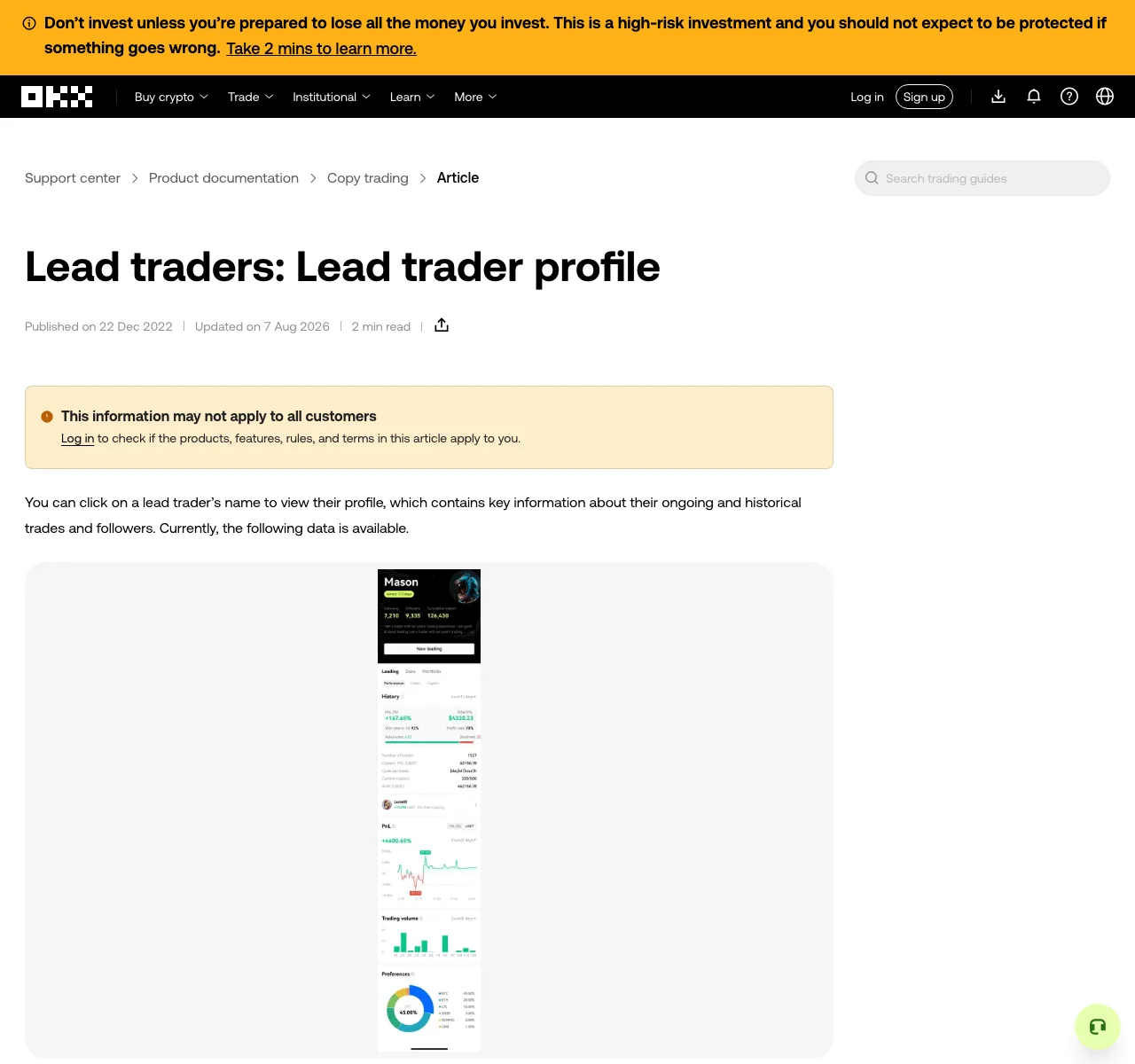
An OKX copy trading result can differ from the lead trader's return even when the copy feature works as intended. The profile describes the lead trader's past performance over a selected period; your account starts copying on a particular date, uses your own order settings, and records your own fills and costs. Compare the same trades and time window before deciding whether anything went wrong.
Screenshot of OKX's public lead trader profile guide, captured October 5, 2026. The profile image is OKX's documentation example, not a screenshot of a reader's account or a verified trading result.
First, compare the same measure
OKX describes a lead profile's PnL% as profit divided by cost, with transfers considered in the cost calculation. The profile can show different periods, such as the last 7 days, 30 days, or all time. It also shows copy trader PnL, which OKX defines as the combined profit of all followers, not the return of one follower. None of those figures is automatically comparable with your own account's net result since you joined.
Open the lead profile and note the product, selected period, and metric. Then open your copied-trade history for that same product and period. Separate positions still open from closed trades: an unrealised position value and a realised result answer different questions. If you joined halfway through the profile period, the earlier lead trades were never yours to copy.
For a broader review of the profile before following anyone, use our lead-trader statistics and risk-limit checklist. A high historical PnL% alone cannot tell you what your next copied order will earn.
Six reasons the trade records can diverge
1. Your entry and exit prices can differ
A copied order reaches the market separately from the lead order. OKX's Spot copy-trading FAQ says the follower's selling price may differ from the lead trader's price. Its Spot and Futures help pages also describe price protection that can prevent an opening order when the price gap is too large. Protection can stop a particularly poor entry; it does not promise identical prices for orders that do execute.
Compare the actual fill price and time for a matched instrument and direction. Do not infer the cause of a gap from the leaderboard alone. Price movement and available liquidity are possible explanations, but your order record is the evidence for what your account actually received.
2. You may have copied fewer trades
OKX lists insufficient trading balance, an order below the market minimum, a reached maximum total amount, and price protection among reasons an order may fail. A lead profile can therefore include a trade that never opened in your account. A smaller set of trades can perform very differently from the full sequence, even if the copies that did open followed the trader correctly.
Check the notification and order history for each missing entry. Our failed-copy-order checklist explains how to distinguish a rejected order from an open or partially filled one. Raising a limit solely to chase a missed trade increases exposure without recreating the original entry.
3. Your position size and controls are yours
Fixed and proportional copying assign different amounts to an order, and the maximum total amount can prevent later entries. Depending on the product, your stop-loss or take-profit setting can also close your position before the lead trader exits. The same market move applied to different position sizes or different exit times produces different account results.
Review the settings that applied when the order opened, not just the settings visible today. Compare your product and position size with the trade you meant to follow. For Futures, check margin mode and leverage as well; a Spot copy and a leveraged Futures copy should never be treated as equivalent exposures.
4. Your costs reduce your net result
OKX says copied trades incur the regular trading fees for the account's tier and may owe a share of eligible profits to the lead trader. Futures positions can also have funding payments. These items can make the cash result in your account differ from a headline performance figure even when entry and exit prices are close.
Inspect your own fee and profit-sharing records rather than applying a rate seen on another trader's page. OKX's rules describe withholding and later settlement of profit sharing, so a pending amount may differ from the final charge. Our guide to copy-trading fees and profit sharing explains the line items and where to check them.
5. You may have exited on a different date
OKX permits a Spot follower to sell a copied holding before the lead trader sells. A follower's stop-loss can also end a position earlier. Once your exit differs, comparing your result with the trader's eventual exit no longer measures the same round trip. Check the close time and reason in your history before assuming the platform calculated PnL incorrectly.
6. The displayed numbers can use different scopes
A trader's periodic PnL%, the aggregate PnL of all copiers, your open-position value, and your realised net profit each have a different denominator or scope. Comparing two percentages without the underlying dates, capital and fees can create an apparent discrepancy where the records are simply measuring different things. Start with one matched closed trade, then expand to a whole period only after the trade-level records make sense.
A practical way to reconcile a gap
- Record the comparison. Write down the lead trader, Spot or Futures product, profile period, and the exact metric you are reading. Do not use an all-time profile figure to judge a copy relationship that began recently.
- Check your copied orders. In OKX's copy-trading area, review ongoing and historical positions. Match instrument, direction, open time, close time, filled amount, and fill prices. Menu labels can differ by account and region.
- Find absent or early-closed trades. Read any failure notifications and check whether your own limits, balance, supported market, or exit settings explain them. Confirm whether a position is still open before taking further action.
- Reconcile the net amount. Review trading fees, any profit-sharing entries or later adjustments, and funding for Futures. Keep pending and settled amounts distinct.
- Escalate a specific mismatch. If an order record, notification, and account balance still disagree, contact OKX through its verified support channel with the non-sensitive order details and times. Never include a password, API key, recovery phrase, or full account screenshot.
The useful conclusion is a documented reason for your result, not a promise that the next copy will match the lead trader more closely. If the gap comes from a risk control, understand why it was triggered before changing the setting.
Common questions
Does a lower follower return mean the copy feature failed?
No. Start by checking whether you copied the same trades, entered and exited at the same prices, and are comparing results after the same costs. A failed or missing order is one possible cause, but different dates and calculation scopes can also explain the difference.
Can I recover a missed trade by increasing my balance?
Do not assume so. OKX's Spot failure guide says a trade that already failed is not placed later merely because funds were added. Check the next order independently and decide whether a larger allocation fits your own risk limit.
Is the lead trader's PnL% my expected return?
No. It describes historical performance under OKX's stated calculation and period. Your future orders, entry prices, size, costs, and exit decisions can differ. Crypto trading and especially leveraged Futures can result in substantial loss.
Official sources checked
- OKX: Lead trader profile — definitions and periods for profile metrics.
- OKX: Spot copy trader guidelines — copy settings, fees, and profit-sharing records.
- OKX: Spot copy-trade failure reasons and Futures copy-trade failure reasons — skipped orders and price protection.
- OKX: Spot copy trader FAQ — different selling prices and early exits.
- OKX: Profit-sharing rules — withholding, netting, and settlement.
Sources checked October 5, 2026. Product availability and interface labels vary by region and account. This is educational information, not investment advice.