
Getting Started
Too Little Crypto to Sell on OKX? How to Clear Dust Balances With Convert
A leftover balance that spot trading refuses isn't a glitch: every OKX pair has a minimum order size, shown as "Min" in the order form. Here's why DOGE/USDT needs 10 DOGE, how Convert's near-zero threshold clears the remainder, and when even Convert won't take it.
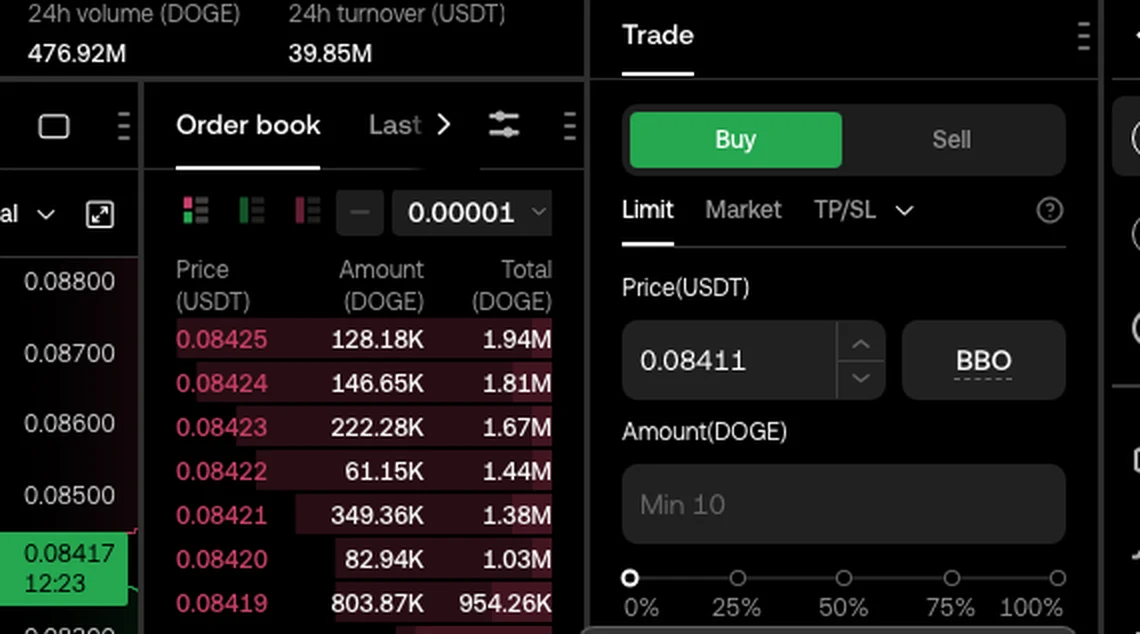
You finish a trade and a sliver is left behind: 7 DOGE, 0.000004 BTC, a handful of a token you bought once and forgot. You go to sell it on the spot market, type the amount, and the Sell button stays dead — or the order is rejected outright. Nothing is wrong with your account. The amount is simply below the minimum order size for that pair.
Every spot pair has its own minimum order size
The spot order book is a market between users, and each trading pair carries a minimum quantity per order. It is not a single platform-wide number — it is set per pair, and the order form tells you what it is. On DOGE/USDT the Amount box shows Min 10, so 7 DOGE cannot be sold there no matter how you phrase the order.
A few current values, read from OKX's public instruments endpoint on 13 October 2026:
| Pair | Minimum order size |
|---|---|
| BTC/USDT | 0.00001 BTC |
| ETH/USDT | 0.0001 ETH |
| SOL/USDT | 0.01 SOL |
| OKB/USDT | 0.01 OKB |
| DOGE/USDT | 10 DOGE |
Two things follow. First, the limit is about quantity of the coin, not its dollar value — 10 DOGE is under a dollar, while 0.0001 ETH is worth far more. Second, these numbers get adjusted from time to time, so treat the "Min" hint in the order form as the authority rather than any table, including this one.
Withdrawing the leftovers usually fails for the same reason from the other direction: withdrawal minimums exist too, and the network fee on a small chain transfer often costs more than the dust is worth.
Convert accepts what the order book won't
Convert is a different mechanism, not a different button for the same thing. Instead of placing an order into the book, you request a quote and accept it: OKX's help centre describes it as a quoting model with "no transaction fees or slippage", where the price you preview is the amount you receive, and states that it lets you exchange crypto at a lower threshold than the spot market — the minimum is "close to 0".
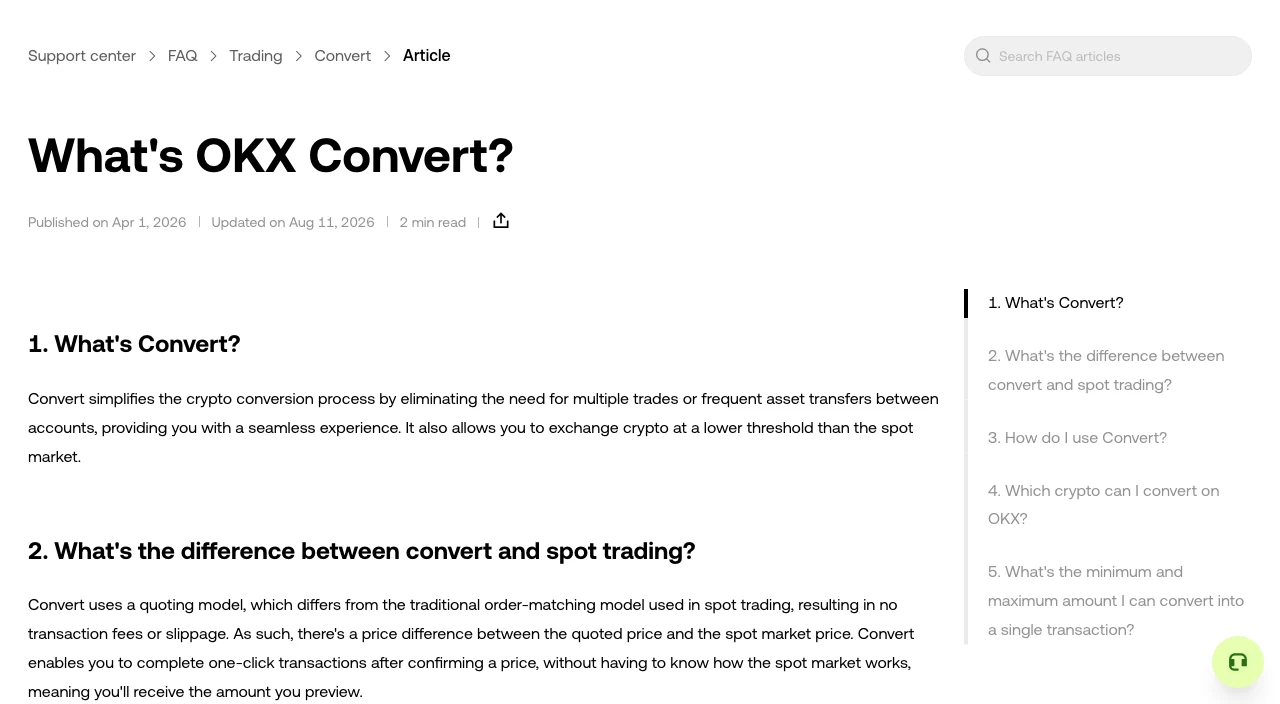
That lower threshold is the whole point for dust. The cost is baked into the quote as a spread rather than charged as a visible fee, which is why Convert is the expensive choice for ordinary trades — we compare the two paths in detail in Convert versus spot trading on OKX. On a balance worth a few cents, a spread that would matter on a $2,000 swap is irrelevant; on anything you'd actually miss, go back to the order book.
Clearing the dust, step by step
- Note where the balance actually sits. Dust in the funding account and dust in the trading account are separate piles; Convert works from the account holding the coin, so check both. If the tab layout is still unfamiliar, the guide to the OKX app's tabs and buttons maps them out.
- Open Convert (web: the Trade menu; app: the Convert entry on the trading screen).
- Set the "from" coin to the dust asset and use the max or percentage control rather than typing the number — leftovers often have more decimal places than you expect, and a manually typed figure leaves a remainder behind.
- Pick a sensible destination. USDT or another stablecoin keeps the result easy to reuse; converting dust into a third volatile coin just creates different dust.
- Read the quote before confirming. It is only valid for a few seconds. If you hesitate it expires and you'll be shown a new one — that is the market moving, not a penalty.
- Repeat per coin. Convert handles one pair at a time, so ten dust balances mean ten quick conversions.
When Convert can't take it either
- BTC and ETH are restricted. OKX states that BTC and ETH can only be converted with BTC, ETH or stablecoins — so a BTC remainder goes to USDT, not directly into some small-cap token.
- The coin needs a spot market. OKX's help centre notes that, aside from the BTC/ETH restriction, pairs convertible via Convert are those that have a spot trading market. A delisted or never-listed asset has no quote to give you.
- The amount can round to nothing. "Close to 0" is not zero. A balance worth a fraction of a cent may quote out at zero of the target coin, in which case leaving it alone is the only sensible move.
- Regional availability varies. Not every product is offered in every jurisdiction, so the entry point may be missing on your account rather than broken.
If you want to rehearse any of this without touching real balances, demo trading lets you place and reject spot orders freely — useful for seeing exactly where the minimum-size wall sits before it costs you a real attempt.
Questions people ask
Does converting dust cost me anything? Not as a listed fee. The cost is the gap between the quoted rate and the market rate. In absolute terms that gap on a dust balance is a rounding error; the same gap on a real trade is not.
Why does the minimum differ so much between coins? Minimums are expressed in units of the coin being traded, and coins differ in unit value by orders of magnitude. Ten DOGE and 0.00001 BTC are both "a small order"; the numbers just look nothing alike.
Can I sell dust with a limit order instead? No. The minimum applies to the order itself, regardless of order type or price.
Educational content only — not financial advice. Minimum order sizes were read from OKX's public instruments endpoint and the DOGE/USDT order form on 13 October 2026; Convert behaviour is quoted from the OKX support article "What's OKX Convert?", updated 11 August 2026. Limits change — confirm in the order form before you trade.