
Web3 Wallet & Tools
Chainabuse: How to Check and Report Crypto Scam Addresses Safely
Use Chainabuse to check a crypto address or domain, understand report badges, preserve evidence and file a useful scam report without exposing sensitive information.
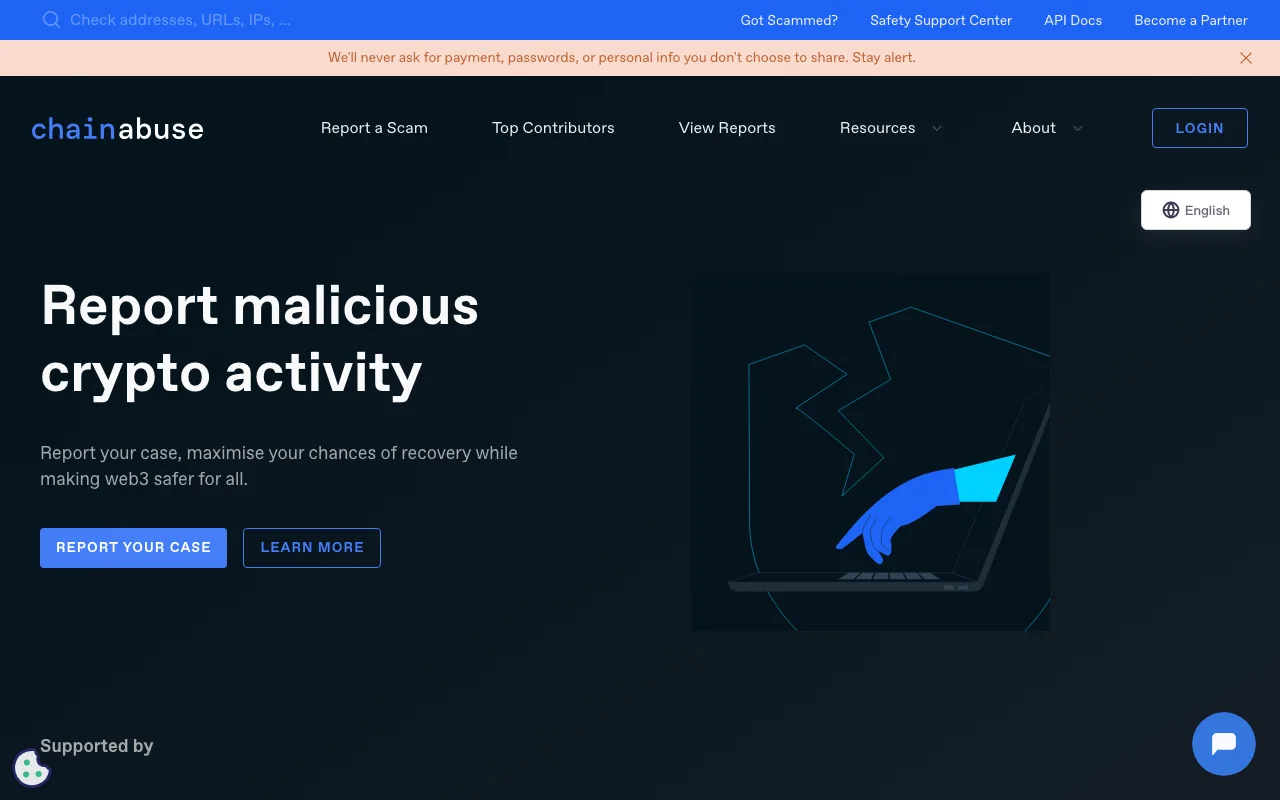
The official Chainabuse homepage on September 15, 2026. No account, victim or report data is shown.
Chainabuse is a public reporting and screening service for crypto-related scams. You can search a wallet address, domain or other indicator to see whether it appears in submitted reports, then review the report date, category and confidence signals. You can also submit your own evidence. It is a useful warning system, but it cannot certify that an unreported address is safe, reverse a blockchain transfer or guarantee recovery.
If someone is pressuring you to pay, do not treat a clean search as permission to continue. Stop, verify the destination independently and never share a seed phrase, private key, password, one-time code or API secret with Chainabuse—or with anyone offering to “help” recover funds.
What to do first
Your next action depends on what has already happened:
| Situation | Safest next step |
|---|---|
| You have not sent funds | Search the exact address or domain, verify the network and check the claimed organisation through a contact channel you found independently. |
| The search finds a relevant report | Stop the payment. Read the full report and preserve the result with the original payment request. |
| The search finds nothing | Treat it as an absence of public reports, not a safety certificate. Continue independent checks and stop if the sender uses pressure, secrecy or guaranteed-return claims. |
| You already sent funds | Preserve transaction and communication evidence, contact the sending platform immediately and report through official channels in your jurisdiction. |
| Someone offers guaranteed recovery for an upfront fee | Do not pay or share credentials. Treat the offer as a possible recovery scam. |
How Chainabuse works
Chainabuse documentation says its reports can contain malicious crypto addresses, contracts, domains, social accounts and other indicators of compromise. Reports may come from victims, investigators or pre-vetted security partners. Moderators screen submissions for spam and assign confidence information.
The public search is best used to answer a narrow question: has this exact indicator been reported, and what evidence accompanies the report? It is not a block explorer, a law-enforcement decision or an automated guarantee about a transaction.
Before searching, identify whether the destination is an exchange account or a self-custody wallet. The differences between an exchange account and a Web3 wallet affect who controls the keys and whether a platform can investigate an account-level issue.
How to check a wallet address or suspicious website
1. Copy the indicator from the original source
Copy the complete receiving address from the payment request or transaction record. Note the blockchain, asset, date and how the address was supplied. For a suspicious website, record the exact domain without installing an extension, downloading a file or connecting a wallet.
Do not shorten the address when you compare it later. Two addresses can share the same first and last characters. Also confirm the network because the same address format may be usable on more than one compatible chain.
2. Open the official site directly
Navigate to chainabuse.com from a trusted browser. Avoid search advertisements and links sent by the person you are investigating. The public site provides a search field for addresses, URLs and other indicators.
Only enter information intended for public verification, such as a public wallet address, transaction hash or suspicious domain. Never enter a seed phrase, private key, exchange password, authentication code or API credential.
3. Search one precise clue at a time
Start with the destination address or domain. If you also have an email address, phone number or social handle, search each separately. Separate searches make it easier to identify which clue produced a match.
4. Match the complete result
Confirm that the result refers to the exact address or registered domain. For an address, check the named chain. Then read the report date, category, description and available confidence badge. A matching string with an unrelated chain or story may not describe your situation.
5. Corroborate outside Chainabuse
Open the transaction hash in the block explorer for the actual network. If someone claims to represent an exchange, wallet or project, find that organisation's official website or app yourself and use its published support route. Do not call a number or follow a support link supplied by the person under review.
What the report badges mean
Chainabuse's current accuracy documentation describes three main signals:
- Checked by Chainabuse means moderators, including blockchain-intelligence specialists, reviewed the report and found enough supporting evidence under their criteria. Chainabuse explicitly says this is not a 100% accuracy guarantee.
- Trusted Contributor means a pre-vetted partner in the Web3 Security Network submitted the report. The badge describes the source; it is not a court judgment.
- Not Verified means the report did not come from a trusted contributor and Chainabuse specialists could not verify it. The documentation says this does not automatically make the report spam, but it should be used cautiously.
The strongest practical warning combines several facts: an exact indicator match, the correct chain, a coherent description, a relevant date, a checked or trusted badge and independent corroboration. A report count or badge alone should not replace that review.
What “no reports found” actually means
An empty search means Chainabuse did not return a matching public report at that moment. It does not prove the destination is legitimate. A scammer can use a new address, rotate domains or act before anyone files a report.
Stop even without a database match if the other party:
- promises guaranteed investment returns;
- demands immediate payment or secrecy;
- asks you to install remote-access software;
- says you must pay a tax, release fee or verification deposit in crypto;
- requests a seed phrase, private key or login code;
- moves the conversation to a different account whenever one is reported.
Behaviour can reveal risk before a shared database has enough history.
Prepare evidence before reporting
Build a factual timeline while the details are fresh. Keep original messages and files, and preserve unedited copies of screenshots before adding annotations. Useful evidence may include:
- the blockchain and complete receiving address;
- transaction hash, date, time, asset and amount;
- the sending address or platform;
- malicious domains, app listings or social profiles;
- the other party's email, phone number or handle;
- payment instructions and relevant messages;
- the name of any exchange or wallet involved;
- a short chronological description of what happened.
Separate observations from conclusions. “I sent 0.2 ETH to address X after receiving message Y” is more useful than an unsupported theory about who controls a larger network.
Remove victim secrets and unrelated personal data before submission. Chainabuse's privacy documentation says public report information focuses on the scammer and that victim information is not published or shared through its API. That policy is not a reason to upload passwords, identity documents, seed phrases or private keys.
How to report a crypto scam on Chainabuse
- Select Report a Scam or Report Your Case on the official site.
- Choose the category that most closely fits what happened.
- Add the malicious address or domain and a short factual description.
- Include the network, transaction hash, loss details and related indicators when known and relevant.
- Review any privacy and contact choices presented by the current form.
- Remove victim secrets and unnecessary personal information before submitting.
- Save the report reference with your evidence pack.
A useful description answers five questions: How did contact begin? What did the other party claim? What action did they request? Which address, domain or transaction resulted? What evidence supports the report? A concise timeline is more useful than speculation.
What to do after funds have been sent
A Chainabuse report is one part of the response, not the final step.
- Contact the sending exchange or wallet provider immediately. Provide the transaction hash, receiving address, chain, amount and timeline. Do not assume a completed on-chain transfer can be reversed.
- Secure affected accounts from a trusted device. Change compromised credentials, revoke unknown sessions and review connected applications. If an exchange integration may be exposed, follow a disciplined process to restrict, rotate and revoke API keys.
- Protect funds that remain. Review saved withdrawal destinations and controls such as an address whitelist for crypto withdrawals. Use the platform's current official help instructions because menus and waiting periods can change.
- Report to the relevant authority. Use the official cybercrime, police or financial-fraud channel for your jurisdiction and keep the case number with the same evidence pack.
- Expect recovery scams. Anyone promising certain recovery in exchange for an advance fee or secret credential creates a new risk.
Frequently asked questions
Is Chainabuse a block explorer?
No. A block explorer shows on-chain transactions and address activity. Chainabuse shows submitted scam reports and related indicators. Use both for their separate purposes.
Does a clean search mean a wallet address is safe?
No. It means no matching public report was returned at that moment. New or unreported scams may have no history, and malicious operators can rotate addresses.
Can Chainabuse recover stolen crypto?
Submitting a report can help organise and connect evidence, but it does not guarantee recovery. Treat guaranteed recovery claims, advance fees and requests for wallet secrets as warning signs.
Can I search without creating an account?
The public homepage provides a search field. Account or form requirements may change for submitting and managing reports, so follow the current prompts on the official site rather than an old tutorial.
Should I include a transaction hash?
A transaction hash is public on the blockchain and can be useful evidence. It may still reveal links between addresses and activity, so disclose only what is relevant. Never disclose a seed phrase or private key.
Bottom line
Use Chainabuse to check whether an exact address or domain has been reported, then judge the report in context and corroborate it independently. A credible match is a reason to stop. An empty search is only an absence of public data—not a reason to ignore pressure, secrecy or requests for credentials.
Last reviewed: September 15, 2026. This article is educational and does not provide legal, financial or recovery advice.