
Futures & Margin Basics
OKX Funding Rate Explained: Formula, Timing and Position Cost
Find the OKX funding rate and countdown on web or app, calculate an illustrative payment, check the contract interval, and verify actual charges in trading history.
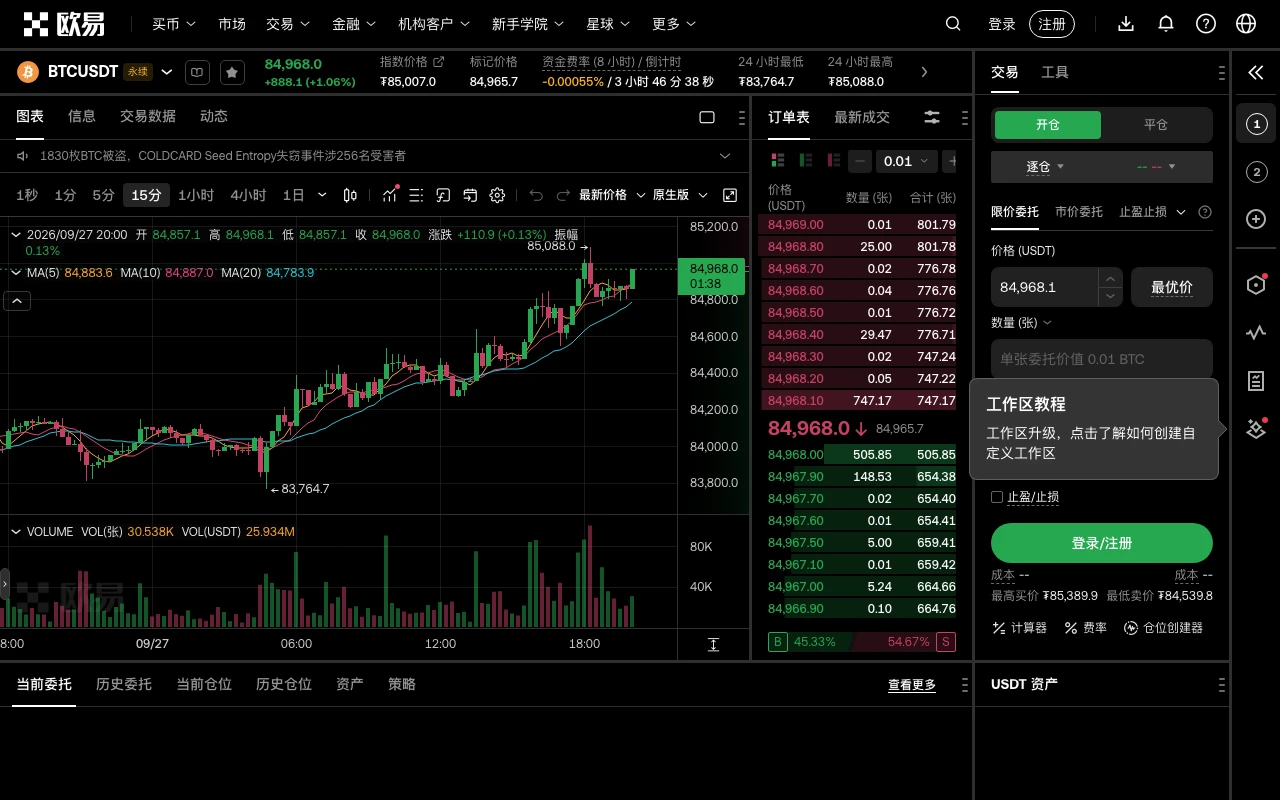
A perpetual futures position can gain or lose value even when the market price barely moves because traders periodically exchange a funding fee. To estimate the cost, check the position value, current funding rate and that contract's settlement interval; the rate can change before settlement.
What the OKX funding rate means
Perpetual contracts do not expire. Funding helps keep their price aligned with the underlying spot index:
- With a positive funding rate, long holders pay short holders.
- With a negative funding rate, short holders pay long holders.
- At 0.00%, neither side pays a funding fee for that settlement.
OKX states that the platform does not retain this funding fee; it is exchanged between position holders. Trading fees and margin borrowing interest are separate costs.
How the funding fee is calculated
OKX gives the core formula as:
Funding fee = position value × current funding rate
For an illustrative calculation only, a 10,000 USDT position at a 0.01% funding rate produces a 1 USDT funding fee for that settlement: 10,000 × 0.0001 = 1. Whether you pay or receive it depends on the sign of the rate and your position direction.
The calculation uses position value, not just the margin posted. Leverage therefore makes a seemingly small funding payment larger relative to your own capital.
When OKX funding is charged
Eight hours is common, but it is not universal. OKX's current FAQ says some contracts settle every 1, 2 or 4 hours, while others use the standard 8-hour schedule. The contract trading page displays the current rate, countdown and interval.
You pay or receive funding only if the position is open at the settlement timestamp. Closing immediately before settlement solely to avoid one payment may introduce trading fees, slippage and fresh price risk if you reopen, so compare the complete cost rather than treating the timestamp as a free shortcut.
Where to find the rate, countdown and payment records
On the web
Open Trade → Futures and choose the intended Perpetual contract. Select Funding rate / Countdown near the top of the trading screen. If that control is hidden, OKX's help page says to expand the right side and switch to Advanced mode. Confirm the pair, rate sign, interval and remaining time before estimating a cost.
Public interface captured September 27, 2026 without signing in. The Chinese label 资金费率 means funding rate and 倒计时 means countdown. The displayed rate and market price are a historical snapshot, not a current quote. This screen illustrates one contract; its interval is not a rule for every contract.
In the app
Open Trade → Futures, choose a perpetual pair, then open Candles → Info → Funding rate. The official instructions identify the rate, cap/floor, countdown and funding period in this panel. Labels and availability can vary by region and app version.
After a settlement
To check an actual charge or receipt, use Assets → Order center → Trading history on the web, select Perpetual under Instrument and Funding rate under Type. In the app, start from Assets → History → Trading → Trading history, then apply the same product and funding filters. A current rate panel estimates a coming settlement; the history entry records a payment that has already occurred.
Before comparing records, check the contract, time zone, timestamp and whether the amount is an expense or income. Do not mistake a trading commission, a transfer or an unrealized P&L change for a funding payment.
What positive and negative funding can tell you
Funding is also a measure of positioning pressure. Persistent positive funding can indicate crowded long demand; negative funding can indicate stronger demand to remain short. Neither direction is a standalone trade signal. A crowded market can remain crowded, and the price move can overwhelm any funding received.
Use a derivatives dashboard such as CoinGlass to compare rates across venues, but verify the number on the actual OKX contract before placing an order.
Practical checks before holding a position
- Compare the perpetual with spot if your thesis does not require leverage; spot has no perpetual funding fee.
- Include expected funding in the loss limit rather than treating it as an afterthought.
- Check liquidation distance and margin mode with our futures basics and cross vs isolated margin guide.
- Use demo trading to learn the interface, but do not assume its funding or fills reproduce live conditions.
FAQ
Is funding the same as an OKX trading fee? No. Funding is exchanged between long and short position holders; order fees are separate.
Does funding apply to spot trades? No. It applies to perpetual futures. Margin borrowing interest is a different mechanism.
Can receiving funding eliminate price risk? No. Price movement, liquidation, execution and platform risks can outweigh the payment.
Official source checked
- Perpetual Futures Funding Fee FAQ, checked September 27, 2026.
Educational content only. Leveraged crypto products involve substantial risk and may not be available in every region.